 by Adam Wesołowski
Is quantum computing’s future in the hands of AI?
A perspective on AI-guided quantum technology, and what “quantum advantage” means.
About the author
Adam Wesołowski is a Research Scientist at FirstQFM and leads several projects on photonic hardware and algorithms. He is finishing his PhD in quantum algorithm development at Royal Holloway, University of London, having read Theoretical Physics at Lancaster University. He has collaborated with leading researchers at Université Paris Cité and the University of Oxford. His work spans quantum algorithm design, complexity theory, and the development of machine learning models for quantum computing.
What advantage actually means
For thirty years the public case for quantum computing has rested on a single word. Speedup. Factor large numbers exponentially faster. Search unsorted data quadratically faster. Simulate molecules that a classical machine could not finish before the sun burns out.
The word did a lot of good. It funded a field and it gave a generation of researchers a clear target. It has also become a liability.
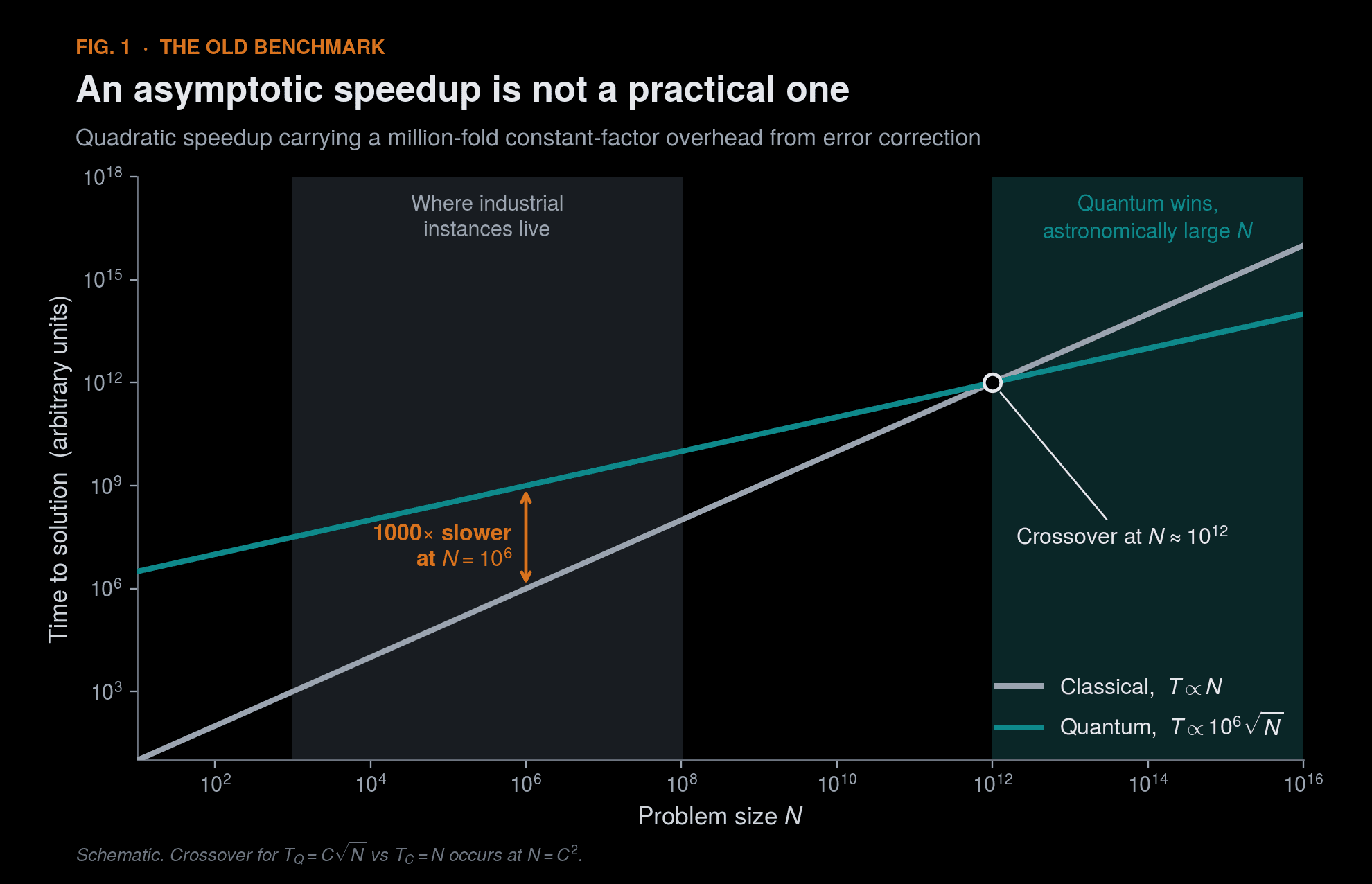
Asymptotic speedups are statements about problem instances which are very often unrealistic. On top of that asymptotic notation hides information about constant multiplicative overheads. For example, a quadratic advantage that carries a million fold constant factor penalty from error correction is unlikely to become useful on any realistic instances. It becomes useful when the problem gets astronomically big. And industrial problems are rarely astronomically big. They are medium sized, heavily structured, and already served by solvers that decades of engineering have made very good. Many of the speedups we celebrate are not large enough to survive the overhead of running them.
We think a different question is the right one to ask.
“Can a system that contains a quantum computer beat the best system that does not?”
That reframing changes what counts as progress. It no longer treats the quantum processor as a rival to the CPU and starts treating it as a component, one unusual instrument inside a larger machine that is increasingly operated by learned software.
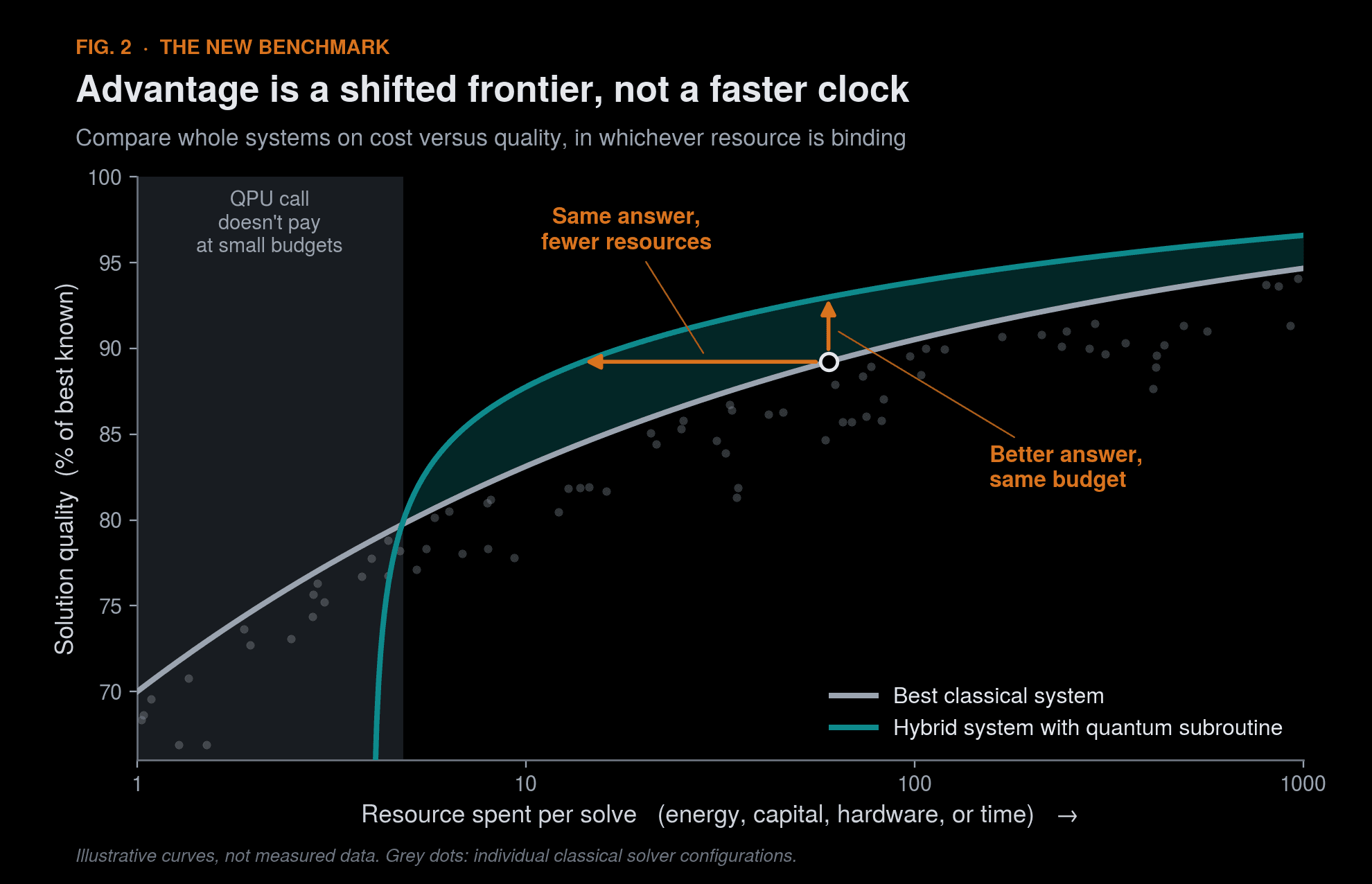
It also changes the unit of advantage, which we think is underappreciated. Time is only one of the resources a computation spends. A workflow also spends energy, capital, memory, bandwidth, engineering hours and tolerance for bad answers. Any of those can be the binding constraint, and in most real deployments the binding constraint is not the clock.
A system that returns the same answer for a fraction of the energy has an advantage. So does one that returns a better answer for the same money, or a wider spread of good answers for a planner to choose between, or one that reaches an acceptable answer on a smaller machine. None of these appear in time complexity analysis. All of them are crucial to businesses from finance to medical research.
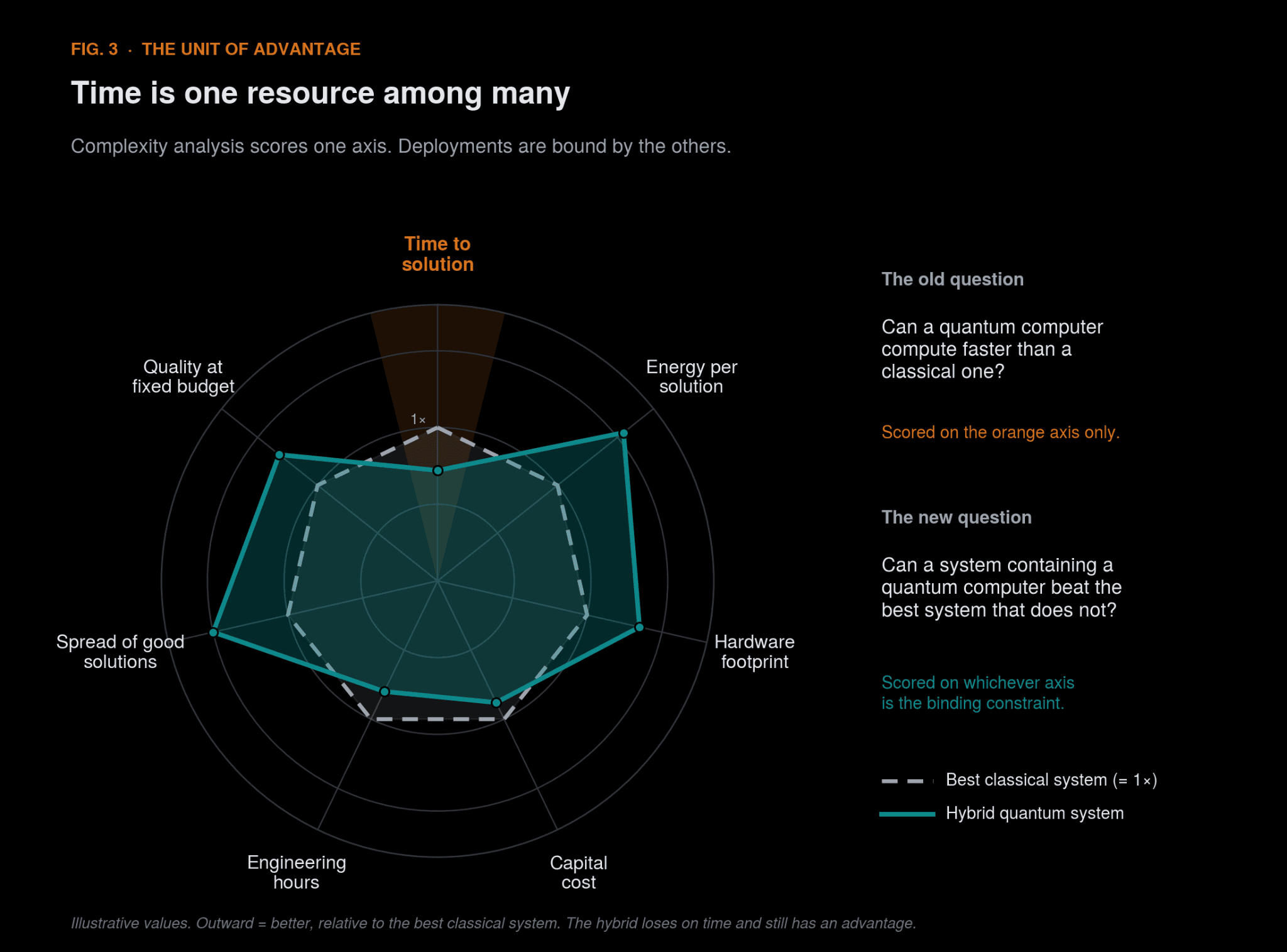
The first measurable quantum advantage may not be the speed of the computation at all. It may be the energy, the hardware footprint or the quality of the answer per unit of cost.
The objective, then, is the strongest overall machine, one with capabilities we did not have, running reliably at lower cost, producing better solutions to problems people actually care about.
Why use AI for quantum computers
We inherited the word computer and it sometimes misleads us. A classical CPU is a device you program. Whereas a quantum processor is closer to a scientific instrument you operate.
Consider what running a superconducting chip actually involves. Qubit frequencies drift over hours, and two qubit gates need pulse shapes recalibrated against that drift. Neighbouring qubits talk to each other when they should not. Readout is probabilistic. Cosmic rays occasionally wipe out correlated patches of the device. The dominant error rate is a moving target rather than a fixed number in a datasheet. It depends on which gates you ran five microseconds ago and on noise you did not model.
So the day to day labour of the field is maintenance. Calibration strategies, error characterization, noise tomography, recompilation, drift compensation. Every hour of useful quantum computation sits on top of many hours of tending. The machine is fragile because it is powerful. Sensitivity to the environment and sensitivity to the computation are the same physical property seen from two sides.
An instrument that needs constant expert attention, whose optimal operating point drifts, whose error structure is high dimensional and only partly modelled, and for which we can generate essentially unlimited synthetic training data. That is a problem well suited to modern machine learning.
Efficiency from learning
One durable observation in AI research is that methods which leverage computation eventually overtake methods built purely on human insight. That observation has a particular edge here, because few fields are as thoroughly hand crafted as this one. Our decoders come from coding theory. Our compilers come from circuit identities proved by hand. Our error mitigation comes from analytical noise models. Our calibration comes from a physicist’s intuition about one particular fridge. In every case a human expert has encoded a simplified model of a system that is not simple.
Each of these also has the property that makes learning work. The reward is exact, cheap and automatic. You can count the gates. You can simulate the fidelity. You can compare a predicted syndrome against a measured one. Quantum computing generates its own quality signal, at scale, for free.
Fields with that property have not historically stayed hand engineered for long.
AI around the machine
There are several places where learned systems already help, and each of these areas can be seen as a potential metric for quantum advantage. AI models will likely outperform human experts in these areas, and these models will ultimately be responsible for the state of the art technology.
Designing the hardware
Chip layouts, qubit couplings, resonator geometries and control pulse shapes live in enormous design spaces with composite objectives. This is where learned search earns its keep. It explores designs a human team would never enumerate, and it optimizes for coherence and connectivity and crosstalk and fabrication yield together rather than one metric at a time. Optimal control of pulse sequences, shaping microwave envelopes to implement a gate faster and more robustly than the textbook waveform, was one of the first places where learned controllers beat hand derived ones outright.
Compiling the circuit
Between the algorithm you wrote and the pulses the machine plays lies compilation. Mapping logical qubits onto a physical topology, inserting swap operations, resynthesizing gate sequences, scheduling. Each of these is a combinatorial optimization problem, most are NP hard, and all of them share the property that the reward is cheap and exact. You can count the resulting two qubit gates. You can simulate the fidelity. You can generate as many training instances as you have compute for.
A compiler that removes 30% of circuit depth does something no asymptotic speedup does. It improves every program that runs on the machine. Circuit depth is the currency of the noisy era, and a shallower circuit also needs fewer repetitions to reach a target precision, which is a very important metric.
Running the machine
Finally, calibration. Which qubits are good today? Which pairs should this job avoid? When is the drift large enough to justify taking the device offline? These are forecasting and scheduling problems, and they carry most of the delivered performance of a system. Almost all of that performance can be improved by AI.
AI inside the algorithm
Everything above sits around the quantum computer. The frontier we care about most is learning inside the algorithm.
Take hard combinatorial optimization, the broad class of problems where a good answer is worth money and an optimal answer is out of reach. Routing is the example everyone recognises. A set of locations has to be visited, vehicles have limited capacity, deliveries have time windows, and the cost has to stay low. The number of possible plans explodes with every stop added, so classical practice is built on heuristics that settle for an imperfect answer quickly. Mature solvers do this well after decades of algorithmic work, which is exactly why the bar for improving on them is high.
The naive quantum pitch is to encode the whole instance as a quadratic binary optimization, hand it to a variational circuit and wait for the answer. It fails for reasons that are now well understood. Real instances need far more qubits than exist. Constraint penalties distort the energy landscape. Training landscapes flatten as circuits grow. And the classical baseline, run for the same wall clock time, wins comfortably.
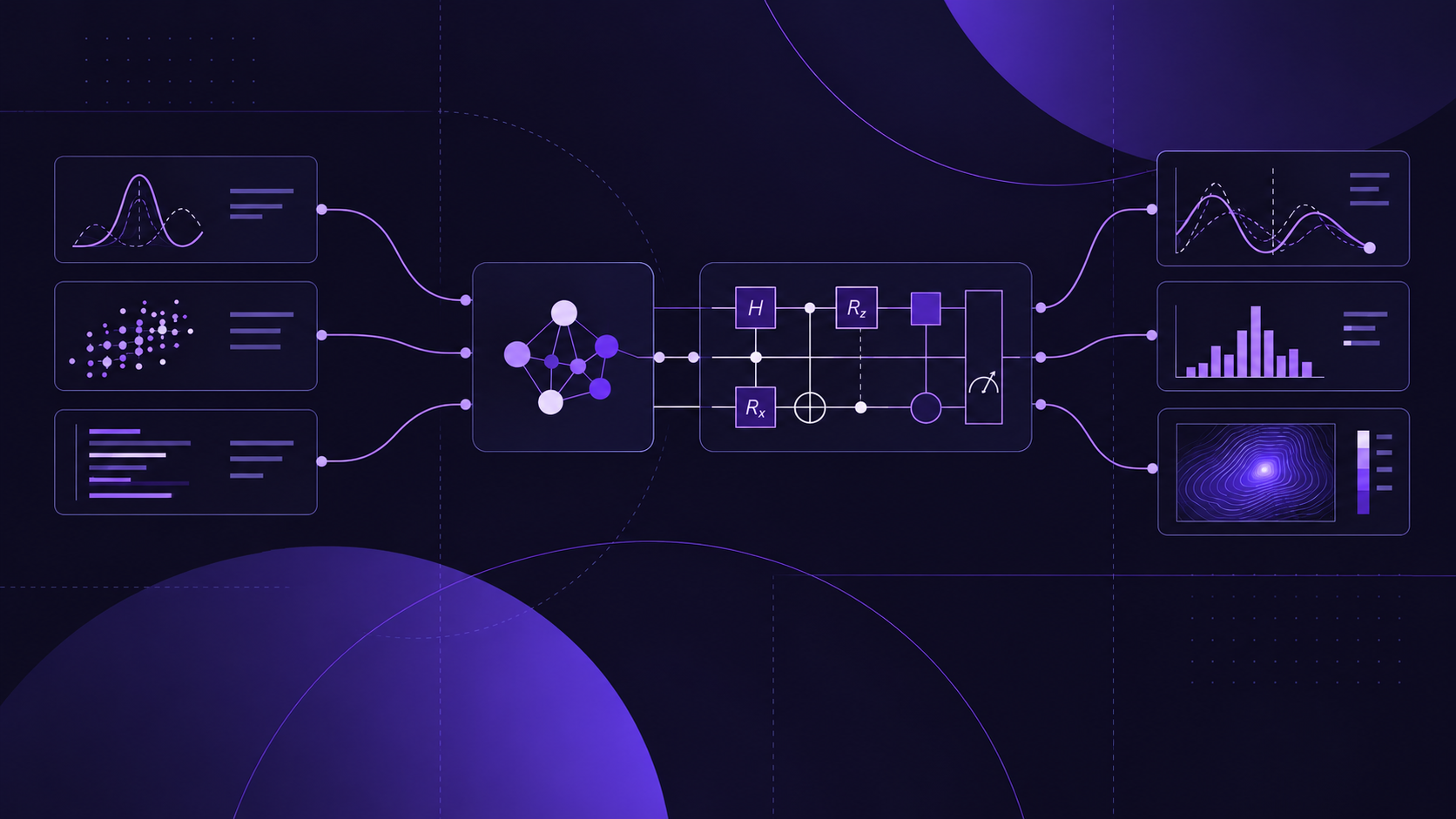
The useful architecture is structurally different. It is hybrid, and a learned model decides where a quantum subroutine is worth calling at all.
A learned model decomposes the problem. Neural networks are good at the thing classical heuristics do by hand, which is reading the structure of an instance and deciding which parts belong together. The model proposes a decomposition, and more importantly it learns which pieces are hard, meaning where the classical heuristic tends to leave value on the table.
The quantum device attacks the small hard pieces. Rather, a handful of tangled subproblems of a few dozen binary variables. That is a size current hardware can hold, and a regime where a device’s ability to produce low energy configurations may be worth something.
A classical solver polishes and validates. The quantum output goes back into the model and is refined there. The device gives advice rather than a final answer.
The quantum processor is invoked only where a learned model expects it to pay for itself, and that payment can be counted in whatever resource the deployment is short of, whether that is energy, hardware, solver calls or the quality of the answer at a fixed budget.
AI can identify the right places to insert quantum subroutines into a classical workflow, and leave the rest of the workflow alone.
Where this leaves us
A broadly accepted result in which a quantum component is clearly and reproducibly responsible for beating a well tuned classical system at equal cost has yet to emerge. That remains a demanding benchmark for the field.
What we are building at FirstQFM is an architecture designed to make that kind of demonstration possible.
If a practical quantum advantage arrives, we expect to see it on an energy bill or a hardware budget before we see it on a stopwatch.
FirstQFM’s mission to bring about useful quantum computing with AI foundation models
If the claim is “competitive” rather than “exponentially faster,” the burden of proof shifts to benchmarking on real world problems, which is where, in my opinion, the real advantage of AI-guided quantum computing will be demonstrated. We are building systems which facilitate quantum advantage in the future and extract the most from quantum computing technology today.