
Foundation model-based QRC for enterprise time series forecasting
FirstQFM's alpha-version system outperformed leading time series foundation model baselines on selected zero shot forecasting tasks across held-out series. We are now announcing a broader beta system release to pilot partners.
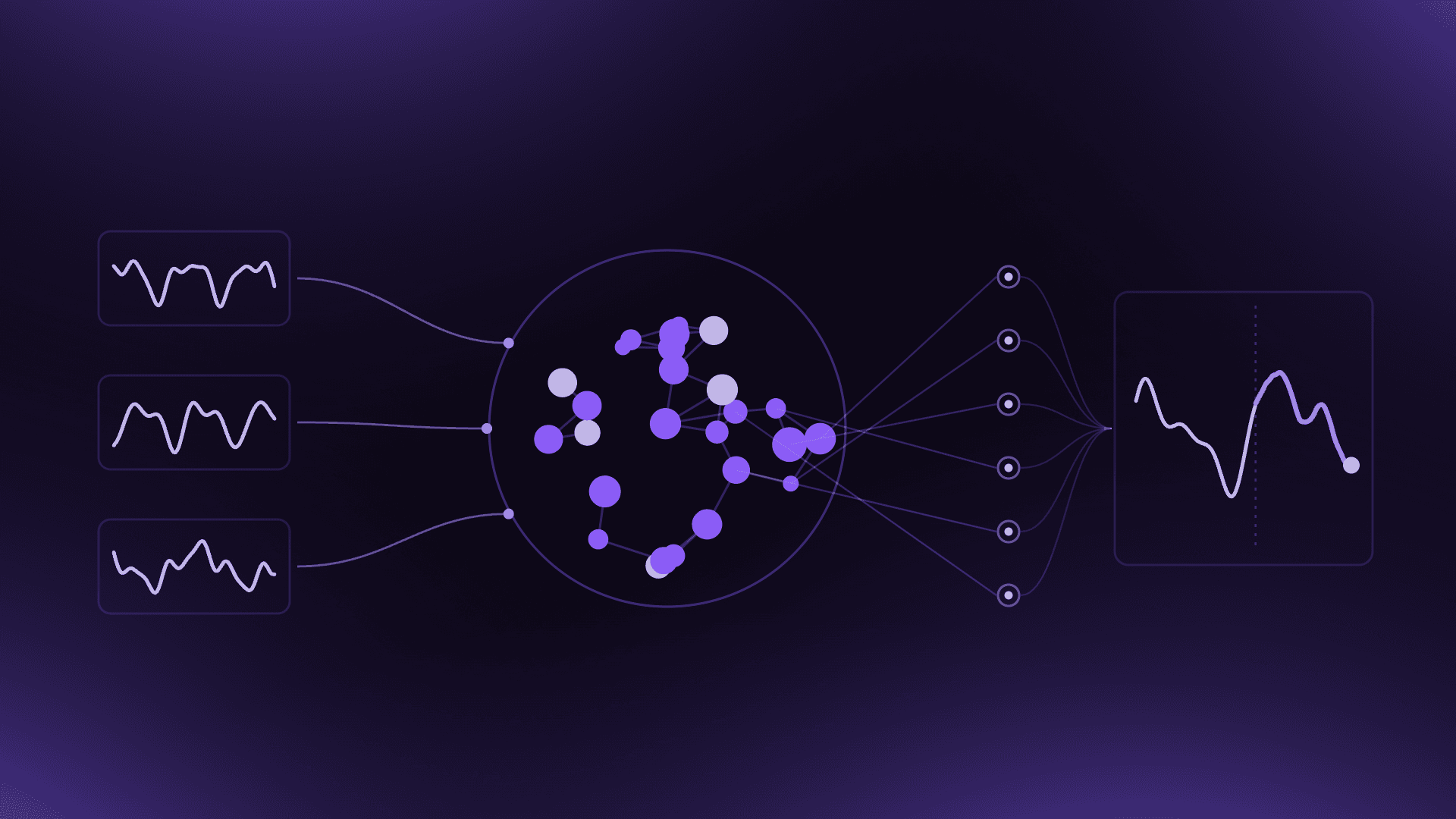
Foundation-model-generated quantum reservoirs for device-aware and problem-aware forecasting
Lower aggregate forecast error than leading zero-shot time-series foundation-model baselines
Multivariate, target-aware, drift-aware, cross-vertical forecasting model
Quantum reservoir computing
Quantum reservoir computing (QRC) is a quantum-classical approach to sequence modeling. A quantum system receives an input sequence, evolves under reservoir dynamics, and is measured to produce a feature representation. A classical readout layer then uses those features for a downstream task such as forecasting, classification, or anomaly detection.
QRC is attractive for near-term quantum computing because it does not require end-to-end training of a deep quantum circuit. It can use relatively shallow quantum circuits, and the classical readout can remain lightweight. In many QRC designs, the quantum system acts as a high-dimensional feature generator inside a broader classical machine-learning system.
Standard QRC implementations use a fixed reservoir. The reservoir is selected once and reused across tasks, datasets, and device conditions. A fixed reservoir may not be matched to the forecasting problem. Additionally, the data distribution may shift, target behavior may change, and the quantum device state can move over time. This makes enterprise deployment challenging.
Foundation model reservoir generation
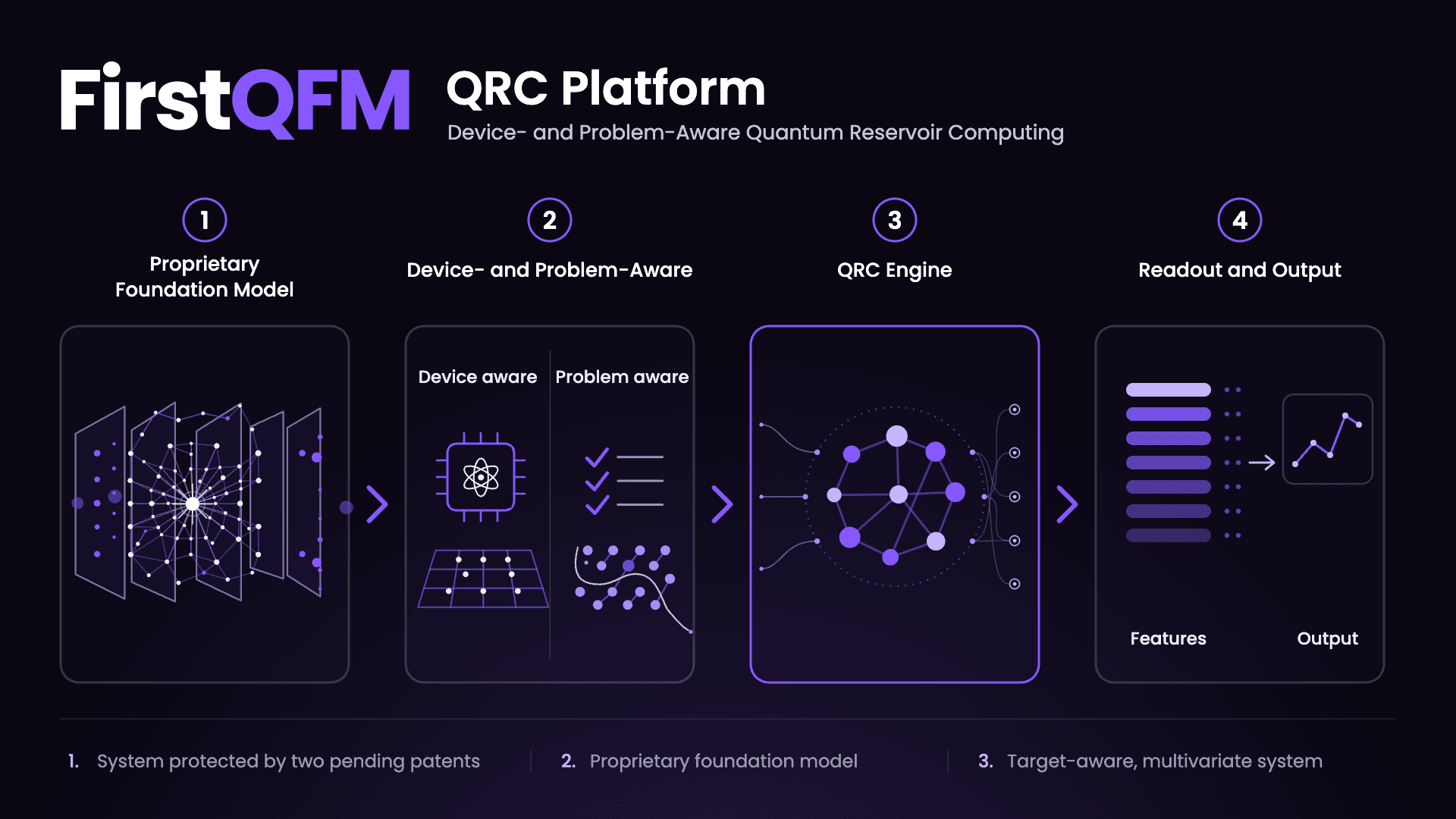
FirstQFM's approach builds QRC on top of proprietary quantum foundation models. The system uses learned context to generate reservoirs matched to the task and the device, rather than relying on one static reservoir design across all workloads.
Problem awareness means that the system can account for differences in forecasting structure. Some series are primarily autoregressive. Some depend on a small number of leading indicators. Others are influenced by many weak covariates, intermittent events, or regime changes. These settings can require different memory and nonlinearity profiles.
Device awareness enables the system to account for the state of a quantum processor. Relevant hardware context can include topology, available operations, calibration conditions, noise indicators, shot budget, and execution constraints.
FirstQFM's QRC system is built on intellectual property protected by multiple pending patents.
NVIDIA accelerated computing
FirstQFM is entering into a long-term collaboration with NVIDIA to support the development of machine learning foundation models for quantum computing. NVIDIA accelerated computing and NVIDIA's quantum-classical software stack, including CUDA-Q and cuQuantum, support critical parts of FirstQFM's development process.
FirstQFM's QRC-based forecasting system requires large-scale training, quantum simulation, hardware-aware development, classical preprocessing, stabilization, readout, and evaluation against strong classical baselines. NVIDIA's hardware and software are a critical component of that workflow.
Alpha benchmark results
FirstQFM's alpha-version QRC system was evaluated on 41 financial return forecasting tasks across foreign exchange, crypto assets, commodities, equity indices, and individual equities.
The primary comparison used leading time-series foundation models from Google, Amazon, Salesforce, and NXAI. These models represent state-of-the-art classical forecasting systems designed for broad zero-shot forecasting. The comparison was therefore zero-shot against zero-shot: FirstQFM's QRC model produced forecasts on held-out series excluded from training, and the time-series foundation-model baselines were run in inference mode on the same forecasting tasks.
Initial benchmarking for the alpha model, shown below, used classical reservoirs that were at the edge of simulability. This enabled a controlled comparison in a setting where classical simulations were too slow for low latency applications, which is crucial for deployment. A reservoir can be technically simulable and still impractical for serving when latency requirements are tight, as they are in some domains, such as finance. Final benchmarking was also performed on Rigetti quantum hardware, where further gains were demonstrated.
Against the time-series foundation-model baselines, FirstQFM's alpha QRC model reported the lowest mean MSE, lowest median MSE, and lowest mean MAE.
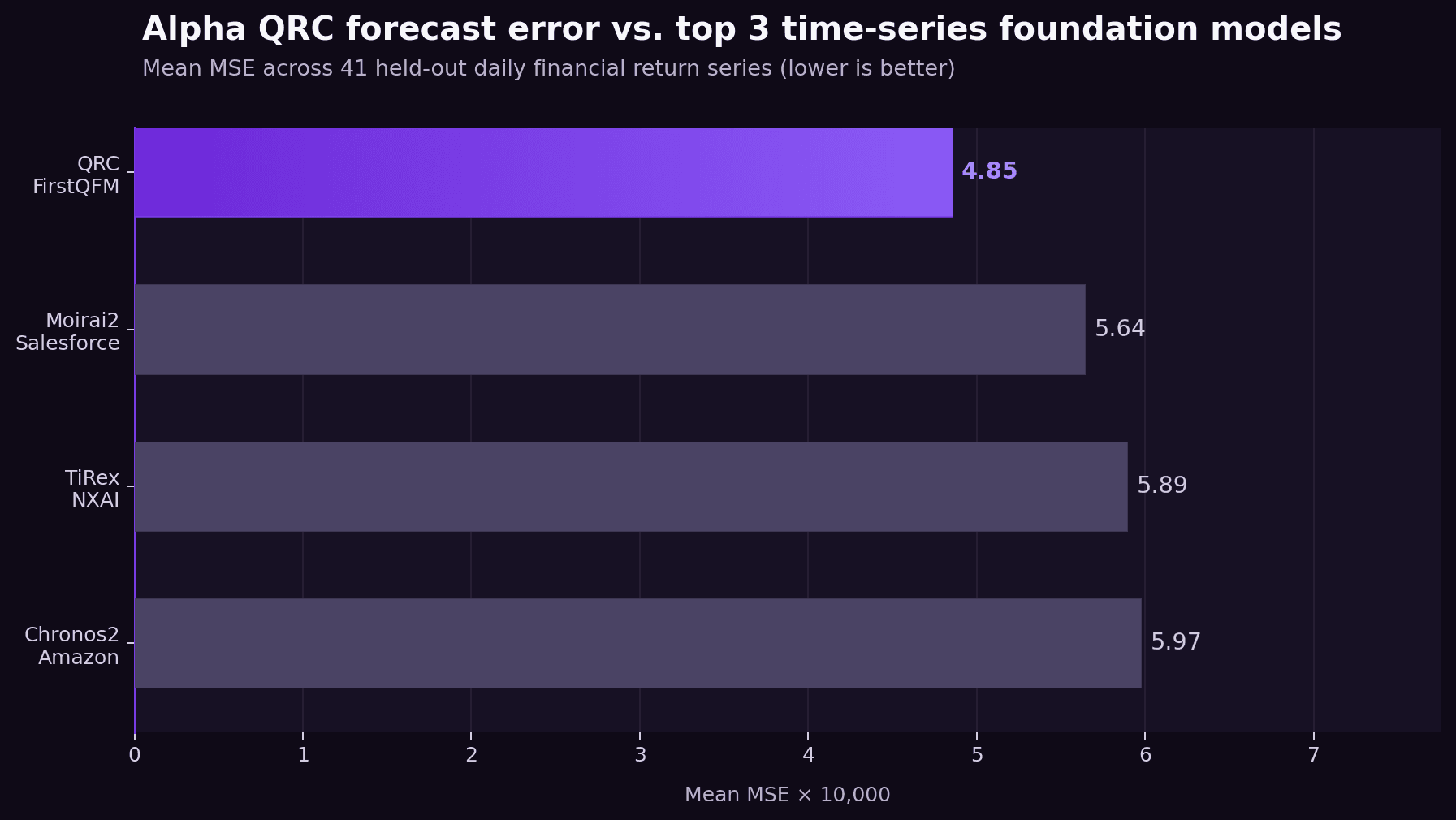
Mean MSE is scaled by 10,000 for readability. In raw terms, the alpha QRC result was 0.000485 mean MSE across 41 held-out daily financial return series, lower than the listed time-series foundation-model baselines.
The broader benchmark suite also included additional machine-learning and statistical references such as autoregression, lasso, ridge, gradient boosting, LSTM, as well as Google's TimesFM 2.5 time series foundation model. Across that broader benchmark, QRC also reported the lowest mean MSE, median MSE, and mean MAE, and best directional forecasting performance.
On a series-by-series basis, the alpha QRC model beat the best time-series foundation-model baseline on 23 of 41 series, a 56.1% win rate.
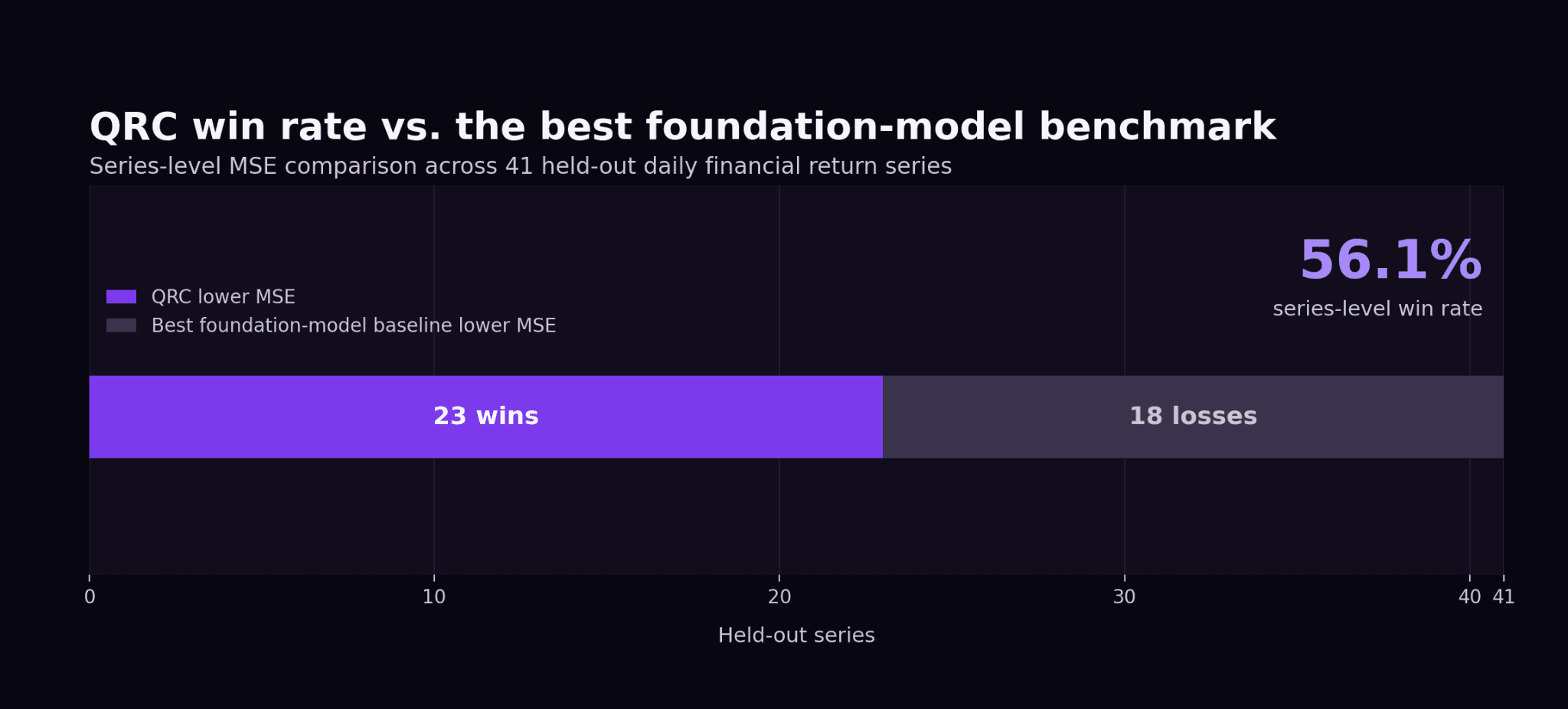
Against the best time-series foundation-model benchmark on each held-out series, the alpha QRC system achieved lower MSE on 23 of 41 series.
The largest single-series MSE reduction against the best foundation-model benchmark was 52.95%. The strongest single-series reductions appeared in indices, crypto, and commodities, including DAX 30, Dow 30, ETH/USDT, BNB, and Brent.
The classically benchmarked alpha reservoir also improved directional accuracy by +3.43 percentage points relative to the last-return benchmark on average, which was higher than any other models used in benchmarking. In hardware evaluations on larger, non-simulable reservoirs using Rigetti's quantum hardware, directional accuracy increased further to 54.74% on average across the 41 series, remaining the best directional result among the evaluated models.
Evaluation approach
Forecasting benchmarks require disciplined evaluation. Strong reported performance is only meaningful if the comparison avoids leakage, overfitting, and post-hoc tuning on the final benchmark examples.
FirstQFM's evaluation was designed around held-out series, forecast-time information, aligned comparison tasks, and strong baselines. The alpha QRC model produced zero-shot forecasts on series excluded from training. Future target outcomes were excluded from task characterization. Baselines were evaluated on aligned targets, horizons, and chronological boundaries.
The evaluation was designed to test whether a QRC system built on foundation-model-generated reservoirs can improve over strong classical references under a controlled comparison setup.
| Method | Implication |
|---|---|
| Held-out evaluation | Final results are separated from the examples used to fit or tune the QRC system |
| Forecast-time information only | Future target outcomes are excluded from task characterization |
| Strong baselines | Results are interpreted against statistical, machine-learning, and time-series foundation-model references |
| Hardware validation | Development covers both simulation and execution on real quantum hardware |
Beta system and pilot release
The beta system extends the alpha work toward broader multivariate forecasting across enterprise workloads. Enterprise time series may include irregular sampling, missing data, exogenous variables, changing regimes, multiple related targets, and operational constraints.
FirstQFM scaled the beta system on a supercomputer as part of the development process. The near-term focus is multivariate forecasting, hardware-aware stabilization, and enterprise workflows where a quantum-generated feature layer can be evaluated against strong classical references.
The system's front end is designed to map heterogeneous inputs into a consistent forecasting workflow while preserving the context needed for target-aware forecasting. The same architecture can return a direct forecast or a reusable feature representation that a customer can evaluate inside an existing model or analytics workflow.
FirstQFM is preparing the beta system for select partner pilots beginning in June 2026.
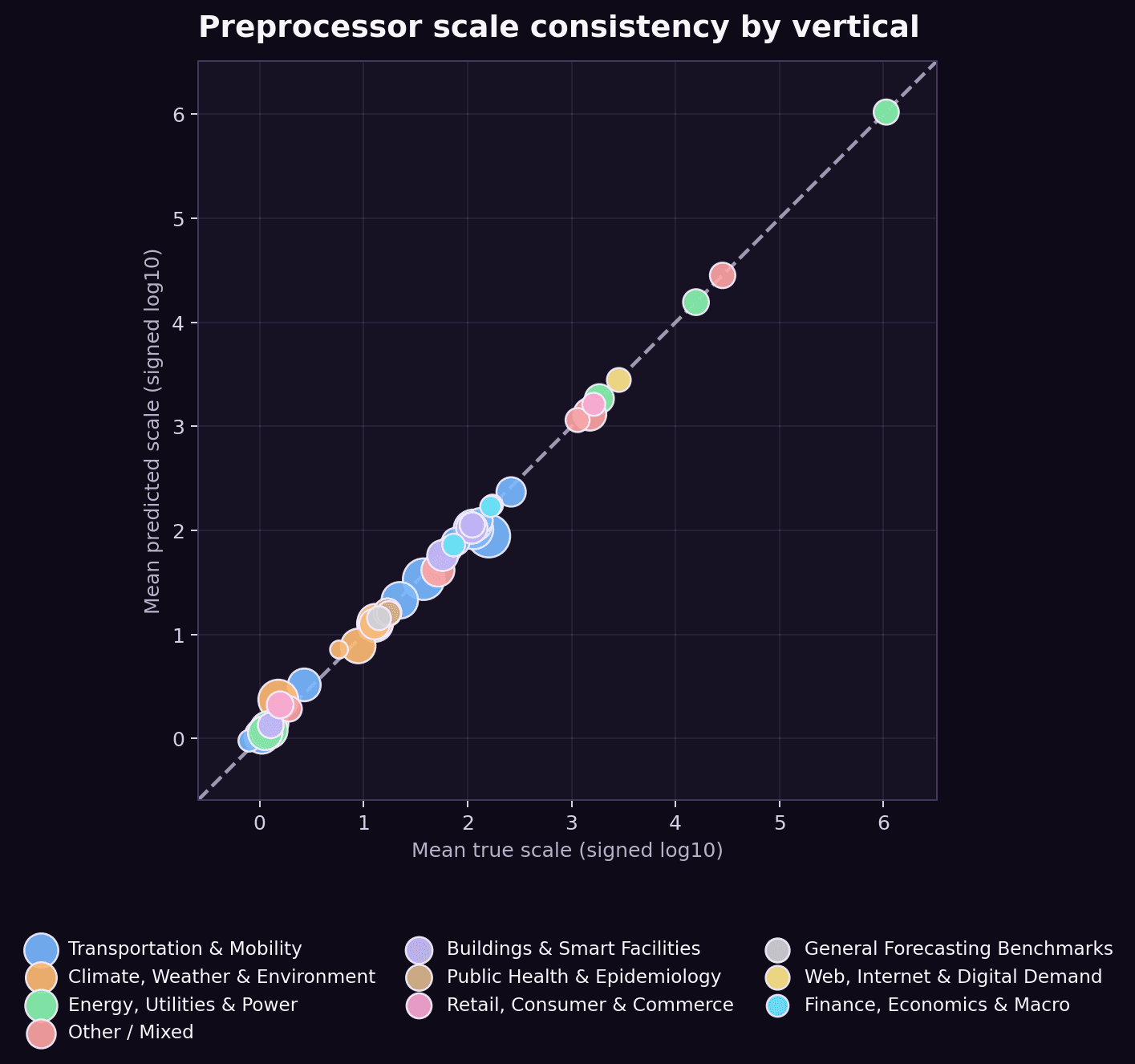
The plot above shows how the beta system handles scale consistency across different time-series verticals. Each point represents a dataset centroid after the system preprocesses the input series, generates a prediction, and maps the output into the target space. The clustering near the diagonal indicates that the front end can normalize heterogeneous inputs for modeling while preserving the scale information needed to return predictions in the original target domain.
Pilot fine-tuning
The beta system is designed to produce zero-shot forecasts by default. For pilot partners, FirstQFM can also fine-tune the system for specific categories of series, forecast horizons, operating constraints, or client data regimes.
Hardware-aware stabilization
Quantum hardware changes over time. In a fixed-reservoir QRC system, those changes can alter the generated feature representation in ways that affect downstream forecasts.
FirstQFM's system is designed to treat device movement as part of the operating environment. It uses hardware-aware context and stabilization around the feature-generation process to preserve useful signal under changing device conditions.
Enterprise controls
Enterprise users can specify product-level controls, such as output mode, latency emphasis, cost emphasis, stability emphasis, forecast-horizon configuration, and serving specialization for a particular workload. No knowledge of quantum computing is required.
| Control | Options |
|---|---|
| Operating profile | Different balances among accuracy, stability, latency, and cost |
| Output mode | Direct forecast or reusable feature output |
| Horizon policy | Forecast configuration aligned to the client use case |
| Target sensitivity | Different emphasis on target history versus broader multivariate context |
| Serving specialization | Narrower deployment variants for specific pilot workloads |
Pilot inquiries
FirstQFM is preparing the beta version of its QRC forecasting system for pilot deployments with selected partners. Teams interested in evaluating QRC for a time-series forecasting application can contact us.