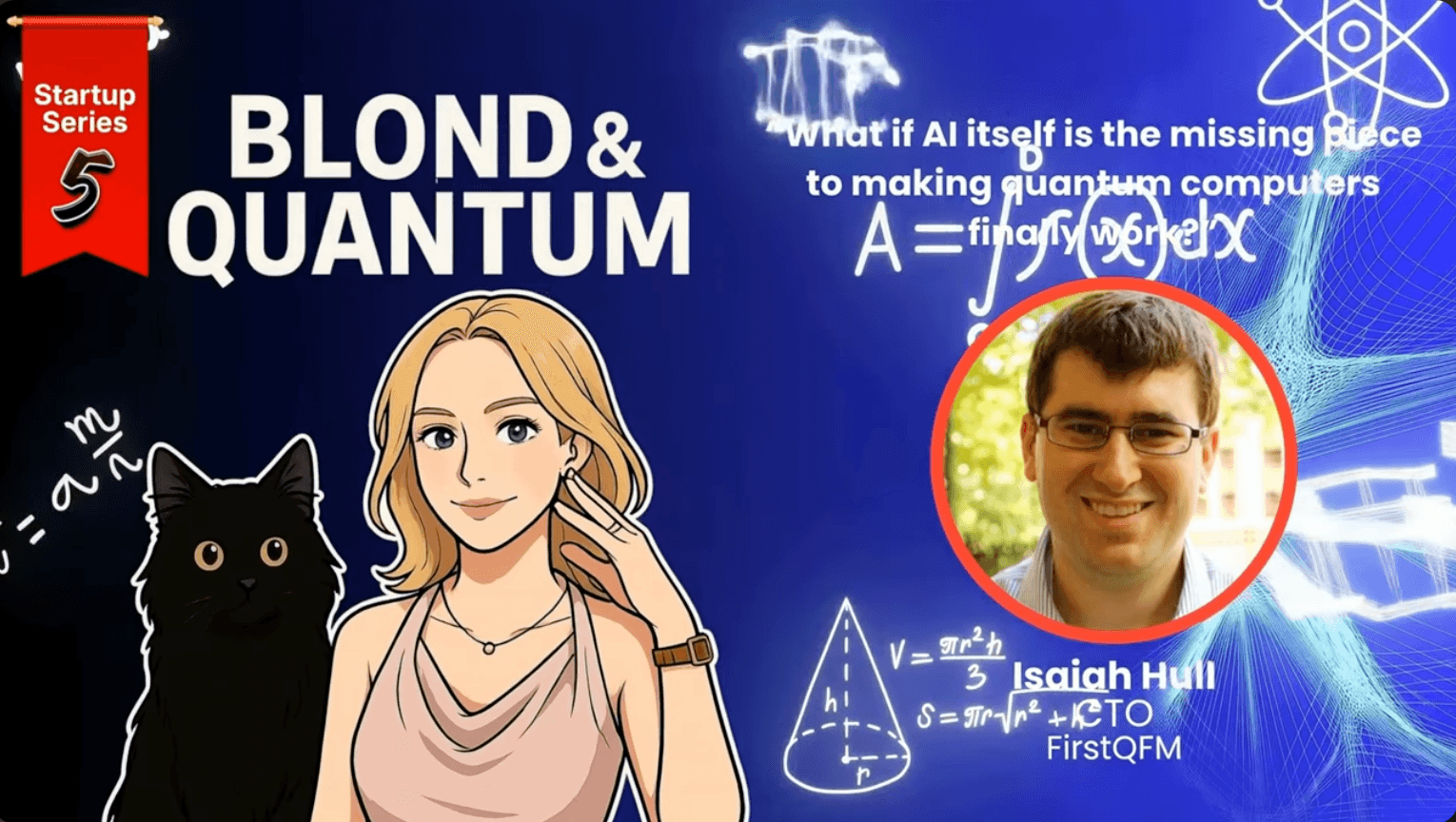
FirstQFM has been selected as one of four commercial and research organizations participating in D-Wave's gate-model beta program for its emerging dual-rail superconducting qubit architecture.
The other organizations admitted are BBVA, Florida Atlantic University, and the Jülich Supercomputing Centre. The program provides early access to D-Wave's dual-rail qubit simulator ahead of the company's forthcoming gate-model quantum systems.
Dual-rail qubits encode quantum information across two modes, allowing many physical errors to be detected and localized as erasures. D-Wave's architecture is designed to detect approximately 90% of errors in this way, with the goal of reducing the physical-qubit and decoding overhead required for fault-tolerant quantum computing.
A core element of the architecture was recently demonstrated in a Nature publication, where D-Wave researchers showed a fast, high-fidelity two-qubit entangling gate that preserves the error-detection properties of the dual-rail approach.
“Error detection creates an opportunity to recover useful information that might otherwise be discarded. Through D-Wave’s beta program, we plan to apply our proprietary foundation models for quantum computing to explore how detected errors, mid-circuit error signals and real-time control can be used to improve the quality and reliability of quantum computations, while preparing these techniques for future testing on dual-rail gate-model hardware.”
FirstQFM develops proprietary foundation models designed to improve the performance and scalability of quantum computing systems. Its technology operates across multiple layers of the quantum stack and is partitioned into two solutions: 1) QFM, which uses proprietary foundation models to improve device performance and scalability; and 2) QFM+, which leverages those models for applications further up the stack.
The company's foundation-model approach is designed to capture the structure, behavior, and constraints of quantum systems, allowing models to incorporate hardware context such as device topology, available operations, calibration conditions, noise characteristics, and execution constraints.
D-Wave launched the beta program as part of its broader gate-model development roadmap. Participants will use the company's simulator to explore error-aware programming approaches in preparation for future dual-rail gate-model hardware.
D-Wave CEO Dr. Alan Baratz described quantum error correction as "a defining challenge in the race to commercially useful gate-model quantum computing" and said the program is intended to allow participating organizations to explore D-Wave's approach to fault tolerance ahead of the availability of its gate-model systems.
FirstQFM was founded in Stockholm and develops machine learning foundation models for quantum computing, with the aim of improving system performance and scalability across quantum hardware modalities.